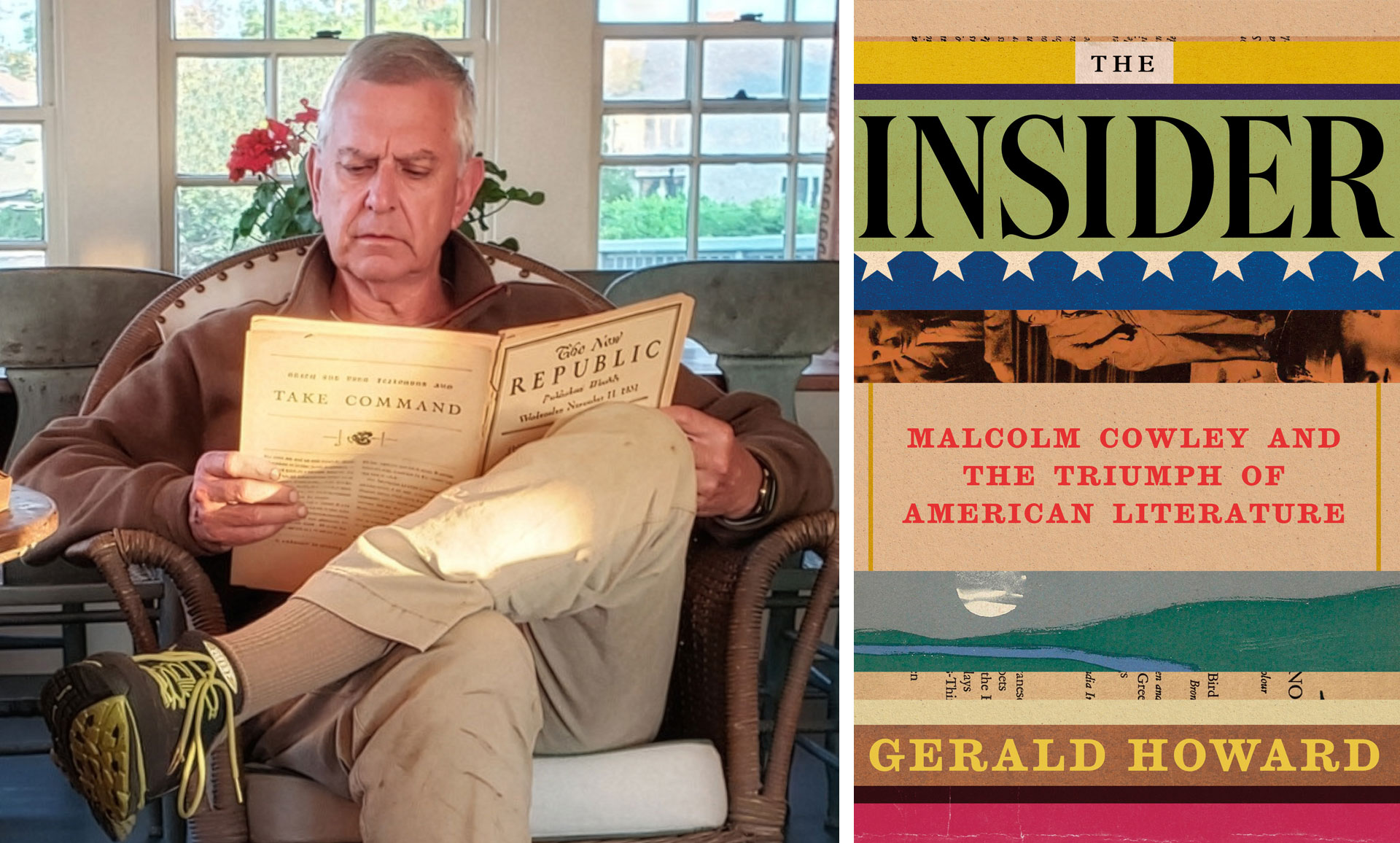
On the Road. The Portable Faulkner. One Flew Over the Cuckoo’s Nest. Each changed the shape of American literature — and all bear the invisible touch of one man: Malcolm Cowley. Editor, critic, midwife to genius, Cowley helped define the canon we still argue over. Yet today, his name barely flickers in the cultural rearview.
At 92NY this fall, editor and publisher Gerald Howard — who has his own history of recognizing singular voices early and helping to shape the first works of giants like David Foster Wallace, Chuck Palaniuk, Irving Welsh and Hanya Yanagihara — joins us to discuss his new biography of Cowley, The Insider: Malcolm Cowley and the Triumph of American Literature. Ahead of the conversation on Tuesday, December 9, Howard sat down to talk to us about why Cowley matters, the art of editing, fighting to publish Fight Club, the value of literature in the age of AI, and more.
You’re coming to 92NY to discuss Malcolm Cowley, a giant of American fiction — as a publisher, tastemaker, and critic — but today he is not a household name. What makes Cowley such a central figure?
For many decades, I have been fascinated by Cowley, and I wrote my book to rectify what I think is a woeful under-recognition of who he was and what he accomplished. When Cowley was the literary editor of The New Republic, he published a story by an 18-year-old writer named John Cheever — his first appearance in print — and Cowley became his mentor. When Cowley was a consulting editor for the Viking Press, he read a manuscript by Jack Kerouac called On the Road, which no one in the company liked but him — it was too crazy, too obscene by the standards of the time, and it contained the hazards of libel. He worked for five years to get it published, and it became a touchstone not just for modern American literature, but American culture. When Cowley was teaching at Stanford, he had a roughneck student named Ken Kesey who had a manuscript set in an insane asylum called One Flew Over the Cuckoo’s Nest. Cowley got it published — again, a touchstone of American counterculture in the 1960’s. And perhaps most conspicuously, he brought William Faulkner back into the spotlight when his career had flatlined. He did this with a brilliant anthology called The Portable Faulkner, and in one stroke corrected years of critical neglect. It’s probably the most important anthology ever published in this country. Over and over again, he found books that changed not just our literature, but our culture.
What makes The Portable Faulkner the most important anthology of American fiction?
Faulkner’s writing is nearly immortal. Fiction written by Southern writers was resurrected — I choose that word carefully — and in enormous debt to him. Latin American writers in the ‘60s and ‘70s — like Gabriel García Márquez, or Mario Vargas Llosa — were wildly enamored of Faulkner, very explicit about what they learned from him in their approaches to the novel. That is an enormous influence, and it likely wouldn’t have happened without Cowley.
One of the things that Cowley did was to establish a canon for American literature, from the Lost Generation to the Beats. Canons can be controversial these days for who they do and do not include. What do you think about the business of canon formation?
I believe that canons are indispensable — they’re always in flux and sometimes they’re wrong, but they’re enormously important. One of the amazing things that I discovered in my research on Cowley was that when he was at Harvard, from 1915-1919, you could not take a course on American literature except for one on Emerson. Nobody thought that the rest of American literature — Edgar Allan Poe, Herman Melville, Walt Whitman, Henry James, Mark Twain — was worth studying. Over the course of the 20th century, that changed, in no small part due to writers in the Lost Generation like Hemingway and Fitzgerald, who Cowley helped discover. That canon had a huge impact on how Americans came to conceive of themselves in the 20th century.
As an editor and publisher, you’ve worked with Paul Auster, Don DeLillo, David Foster Wallace, Hanya Yanagihara, and many others. Publishing is a business driven by the need for instant success and bestsellers, but you have a reputation for discovering books that endure — how do you determine what will resonate in the long term?
I put my finger up to the wind. [Laughs] Seriously though, the first thing I interrogate is my own feeling and enthusiasm for the work. If the feeling is strong, I then ask myself if the book is good for the publishing company. Sometimes I was right, and sometimes I was wrong. I was right about David Foster Wallace’s first novel, The Broom of the System. It launched him. And I was right about Chuck Palahniuk’s novel Fight Club, which I published — nobody else at the company, except for one assistant, thought it was a good idea. But I had an instinct about it — it drove me crazy with a rather dark delight. It was hardly a success right out of the gate, but it gradually began to find a readership, and then when David Fincher came out with that masterpiece of a film, it took off — and now it’s ensconced in our culture. Literary careers are fractal — they are very hard to predict. As a publisher you do your best to follow your instincts.
In the AI era, what is the value of real human editorial work and curation?
An editor has to be in the author’s corner. It’s your job to make the machinery of the publishing business work on their behalf. And then you have to be able to give tough love — to make the author understand when something isn’t working. It’s a peculiar balance of dreaming big and facing up to reality. A real, human editor only learns how to strike that balance with time. Nobody is born knowing how to do it — I sure as hell wasn’t.
You could take a manuscript, submit it to AI for “improvements,” and that entity might well make a sprawling, digressive, overwritten novel like David Foster Wallace’s more streamlined and plot-driven. And from a commercial point of view, that might well be an “improvement” — but you’d be stripping away everything that makes that novel feel unique and alive. So maybe in the next five years they’ll replace people like me with AI. But if I can be blunt — what on earth would the point be? Literature should feel alive.
What do you hope people who come to this event take away with them?
Cowley’s life demonstrates how literary reputations rise and fall, how the books that we value change over time. It’s almost geological — you don’t always see it happening, but the tectonic plates of culture are always shifting. So I hope that people come away with a greater interest in Malcolm Cowley — he lived a fabulously interesting life. And when you’re learning about Cowley, you come away with a greater understanding of the changing arc of American culture in the 20th century.
Gerald Howard discusses Malcolm Cowley and The Insider with Jay Parini on Tue, Dec 9.