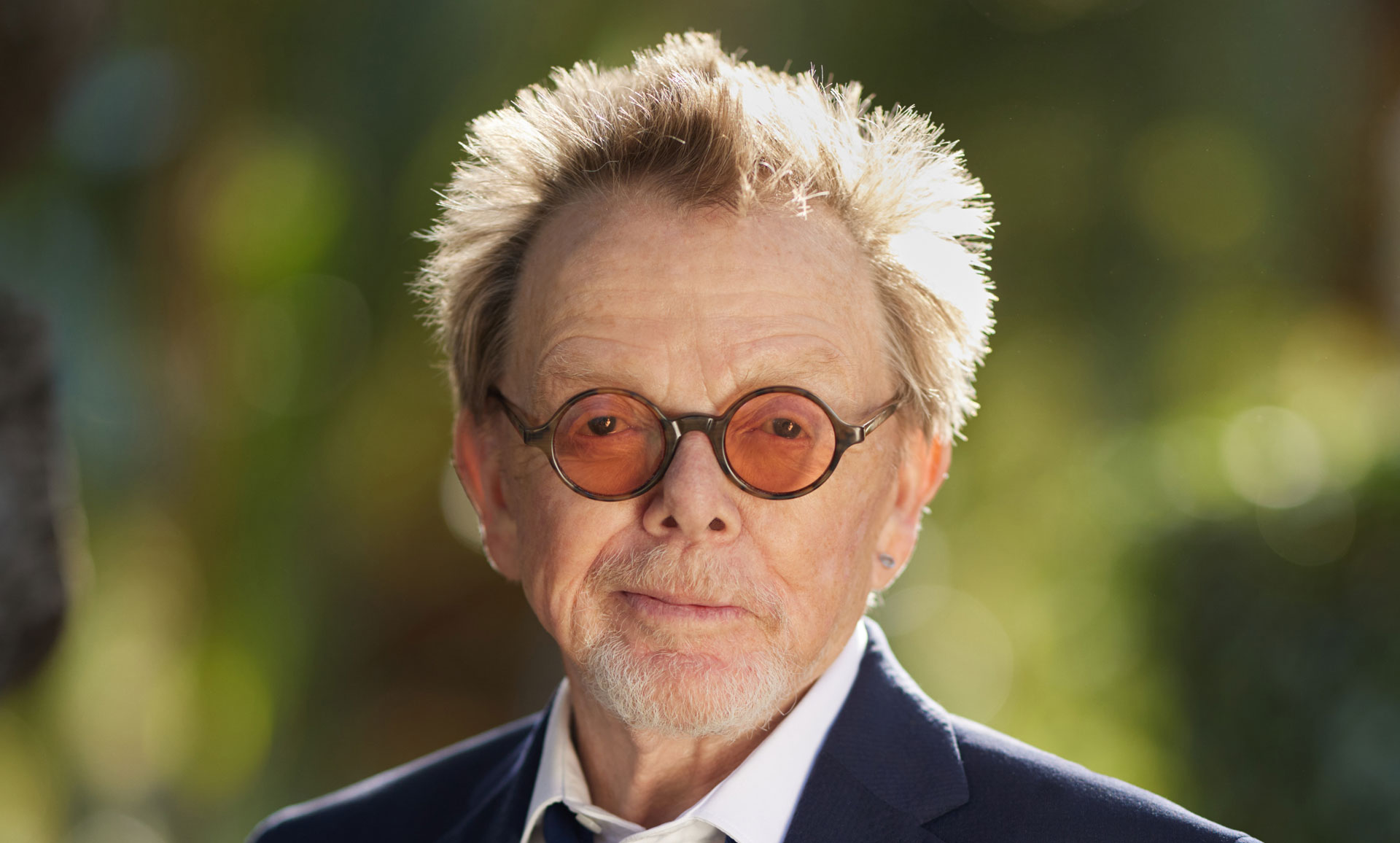
“Evergreen,” “We’ve Only Just Begun,” “Rainbow Connection,” “An Old Fashioned Love Song,” “Rainy Days and Mondays,” “You and Me Against the World,” “Touch” – the Paul Williams songbook spans six decades and artists from Elvis Presley to the Carpenters, Three Dog Night to George Benson, Barbra Streisand to Daft Punk. He’s written for film, acted on screen, won an Oscar, a Golden Globe, and three Grammys, and as if that wasn’t plenty, he’s the president and chairman of ASCAP (the American Society of Composers, Authors and Publishers). We’re thrilled to have the songwriting legend himself – one of music’s most inspiring figures – on our stage for a Lyrics & Lyricists celebration of his songs and remarkable life. We sat down with him ahead of The Lovers, the Dreamers & Me (Dec 6-8) to talk about his ongoing journey as a songwriter, his work with the great Jim Henson, his advocacy for artists’ rights and for recovery, and the life philosophy captured in his own tender lyrics.
Let’s begin before the songs that stole our hearts ruled the airwaves. How did you come to be a songwriter?
I’ve always loved music, but the short answer is because I failed as an actor, making me available for a life writing songs. Going back to my beginnings, my dad was a construction worker, and we were always on the move. I’d been in nine schools by the time I was in ninth grade, and the one thing that was constant was Sinatra, Eddie Fisher, and the music of the Great American Songbook – the music on the radio in the 1940s. When I was nine or 10 we were living in Denver, and my mom and aunt and I went to see With a Song in My Heart, the true story of a singer and actress who’d nearly lost her leg in a plane crash, yet was out there entertaining the troops. I was so captivated I didn’t want to leave the theater, so we stayed and watched the whole movie again. I knew it was the beginning of something I wanted to be a part of.
How I came to be a songwriter: My dad was an alcoholic, and when I was 13, he died in an alcohol-related car wreck. Music was immediately gone from my life. Gone was the kid who’d sing “I’m Yours” for his dad. That door shut, and all I wanted was to be an actor. I wanted to be somebody else. So I pursued that – I did a couple of movies and found I couldn’t make a living at it. But there was this one called The Chase – everyone was in it: Marlon Brando, Robert Redford, Robert Duvall, Jane Fonda – it resulted in the first song I ever wrote (I’ll tell the story of how that happened in the show). I didn’t really start writing songs until a couple of years after that. At first I did it for my own amusement – like writing a journal. It ultimately led to my being asked to write a lyric for a melody by Roger Nichols – the beginning of what would become our collaboration on the Carpenters songs. I was off and running. Nothing that has served me beautifully was ever a plan.
Who were your influences when you began writing those early ’70s hits?
In the mid-to-late ’60s, I fell in love with the Beatles. I’d gone to high school in the 1950s and had somehow completely missed the whole rock-and-roll revolution. I mean, I loved The Platters. I loved the doo-wop groups. I loved when something was really melodic and harmonic and had great rhythms. I lean toward the hopeless-romantic heart — wrenching songs, like Dion’s “ Teenager in Love” – I write “co-dependent anthems,” and I was attracted to them even then! The American Songbook writers were my greatest influences. Johnny Burke (“Here’s That Rainy Day,” “Swinging on a Star”) was one of the best to me. His lyrics are amazing. Also, Rodgers & Hart. Johnny Mercer, of course. And others. But the Beatles changed my life.
Your songs have been sung by icons from Elvis to Streisand to … Kermit. How did you come to work with Jim Henson? And can you talk about writing “Rainbow Connection”?
My work with Jim began when I was a guest in the first season of The Muppet Show. I’d never been a member of a gang that had a treehouse, but when I walked on the set and met Jim and Frank Oz and experienced their humor and quick wit and warmth, I felt I was home. We would have conversations with Kermit and Piggy on their arms (Piggy would sometimes say things you could never say in public!), and Jim and Frank were just sweethearts. Jim had the elegance of kindness. We got along really well. He had just bought a book he wanted to turn into a TV special, Emmet Otter’s Jug-Band Christmas. I wrote the music and lyrics for all the songs, and I think it more or less became my audition for The Muppet Movie.
At that point I had just worked on A Star is Born, and while I wrote “Evergreen” with Barbra, I wrote most of the songs for that film – like “With One More Look at You” – with Kenny Ascher. We also wrote “You and Me Against the World” together. I told Jim I’d love to bring Kenny in to write the music for The Muppet Movie – his melodies are so much more sophisticated than mine – he loved the idea. The first thing Kenny and I did was write the first song, which became “Rainbow Connection.” We wanted to expose that Kermit has an inner life. That he has a soul. And the first line tells us he’s sophisticated: Why are there so many songs about rainbows / And what’s on the other side? There’s a wonderful story about our writing it, which I’ll share in the show. I’ll just say, a song writes itself in some ways, so many times.
I think my philosophy is captured in two songs I’ve written. One is from Bugsy Malone: You give a little love / And it all comes back to you / You know you’re gonna be remembered / For the things you say and do. The other is from “Rainbow Connection” and the lines: Who said that every wish would be heard and answered / When wished on the morning star? / Somebody thought of that, and someone believed it / Look what it’s done so far. It speaks to me of the power of faith and someone on this planet believing in you.
Lyrics & Lyricists has been celebrating the art and craft of lyric writing for over 50 years. “We’ve Only Just Begun” was at the top of the pop charts in the very first L&L season(!), which featured Yip Harburg, Johnny Mercer, and others on our stage. Can you talk about being part of this lineage?
We songwriters are a brotherhood and sisterhood – the headwaters of mutual love affairs. And many of us have careers in music because we were and are just astounded by the beauty of the work of those who came before us. I can take things all the way back to Stephen Foster, who I really began to appreciate through Randy Newman, who I really began to appreciate through Harry Nilsson. Learning from and honoring those who came before is something that’s been part of my life all along, so to now be part of Lyrics & Lyricists, which celebrates all of that – it’s very special.
Aside from hearing some “old fashioned love songs,” can you tell us what people will experience when they see this show?
So many people know me for the songs I wrote for the Carpenters or A Star Is Born, and people will be hearing those songs – there will be some wonderful performers in addition to me — but there are many other areas of music I feel connected to. The kinds of music I love have not always been the kind of music I wrote. While I was writing love songs – songs of longing, or what I call “pick-me-up-and-love-me songs,” probably based on the lack of activity in my love life at the time! – I was listening to and loving the gospel-like rock and roll of a group called The Original Delaney & Bonnie & Friends. I’ve loved everything from Jiminy Cricket (part of why I love Willie Nelson so much is because he shares that warm, friendly sound that reminds me of Jiminy Cricket/Ukulele Ike) to Hoyt Axton to Crosby, Stills, Nash to Joe Cocker to the kings and queens of Laurel Canyon, like my dear friend JD Souther, Joni Mitchell — all kinds of music — and whenever I’ve had an opportunity to write in other genres, it has thrilled me. I’m especially proud of the hard-core rock and roll song for Dr. Teeth in the middle of The Muppet Movie. People are often surprised to hear other sounds from someone they think of as the master of the ballad in the ’70s, and there will be a few songs in this show that will open their thinking.
Your songwriting successes range from the iconic ’70s pop hits to the country charts to Daft Punk and a third Grammy in 2014. What do you think explains your omnivorous musical appetite?
When I was a kid we moved around a lot. As I said, nine schools by the time I was in ninth grade. There was a part of me that was fascinated by the different sounds I would hear – the people, the accents. And having no real roots, I managed to sound like I was from Lucasville, Ohio about a month after I moved to Lucasville, Ohio, then sound like I was from Rapid City, South Dakota a month after I moved there. I’m not someone who goes home and turns music on. So, when I’m walking by a sound, it speaks to me. A new artist with a new sound comes along and it still just knocks me out.
When I’m working with someone new, whether it’s Billy Corgan from Smashing Pumpkins or the guys from the band Portugal. The Man, I feel like I’ve been invited into the sandbox, where I won’t be needing all the rules of songwriting, and I start coloring outside the lines. It’s fantastic. For years I walked into a writing session with a head full of ideas, and God knows how many brilliant songs were never written because my ego had me needing to share the best of mine the minute I walked into the room. I’m a better listener now — a smarter passenger in the writing process. It’s reflective of the way I live my life. We can all either contain and control or trust and grow. Absolutely everything changed through my recovery.
Talk about that a bit – your recovery and its place in your life.
There are two things I’m passionate about, and one is my recovery – I’m 35 years sober. By the time I got sober I was 49, and the career I’d had had been over for 10 years. My dad, both brothers and I were all alcoholics. I started with a watered-down glass of beer when I was five, but I don’t think that was a contributing factor to my vodka-soaked future. I’m not sure exactly when it happened but somewhere in the middle of my life, I crossed over the line from use to abuse to addiction. The ’70s brought success, and with it recognition and celebration. All of a sudden, I was being treated like I was special, and for some of us that’s dangerous. My behavior became erratic, and I moved into the land of denial, becoming a chronic and habitual liar, and hiding the cocaine I was doing and the amount of alcohol I was drinking. My world got smaller and smaller. I went from 49 appearances on Johnny Carson’s couch to peeking out my window at three in the morning looking for the tree police. Paranoia strikes deep.
My connection to the world had always been through my music. When I got sober my connection came through other recovering alcoholics – it brought me into a fellowship and family, and a spiritual life I had never even come close to. It gave me my life back, and a way to live authentically. Gratitude and generosity are fuel.
Let’s talk about your work with ASCAP, and the part of your career dedicated to supporting other writers.
It’s my other passion — music creators’ rights. I’m deeply committed to the work I do at ASCAP. We have 1.1 million members, and when I’m walking around a room filled with songwriters, I think — we all skated in on a dream. There is a sense of community and support that is empowering. And when I’m in Washington, DC talking with a legislator on behalf of songwriters, I try to build a small fire with each conversation, and leave them more informed and more dedicated to protecting creators’ rights. You give a little love, and it all comes back to you. To us.
Finally, it’s impossible not to ask, is there a song of yours that is most meaningful to you?
Yes, and with it a wonderful story: Kenny Ascher and I were writing songs for The Muppet Movie. Kermit is driving cross-country meeting various characters along the way, looking for frogs who wish to become rich and famous. There’s a scene where Piggy, Gonzo, and the others’ car breaks down in the middle of the desert. They’re sitting around a fire, and Kermit is full of self-doubt. He’s trying to get these guys to Hollywood so their dreams can come true, and he feels like he’s failed them. So he wanders off. Now, when you look at a desert sky at night with no lights, it’s almost shocking how many stars you see. Kenny said to me, “Imagine Gonzo – this landlocked bird” (I believe we’re all landlocked birds) “sitting by the fire – he looks up at the sky, and all of a sudden he feels a connection to that world.“ There’s more to the story, which I’ll share in the show. But the song we wrote is “I’m Going to Go Back There Someday.” It’s one of two that were performed at Jim Henson’s funeral. And it’s the song I want at mine. Someday. I love my life.
THE LOVERS, THE DREAMERS & ME: The Songs of Paul Williams — Sat, Dec 6 at 5 PM (new time!), Sun, Dec 7 at 2 PM, Mon, Dec 8 at 7:30 PM. Tickets and details here.