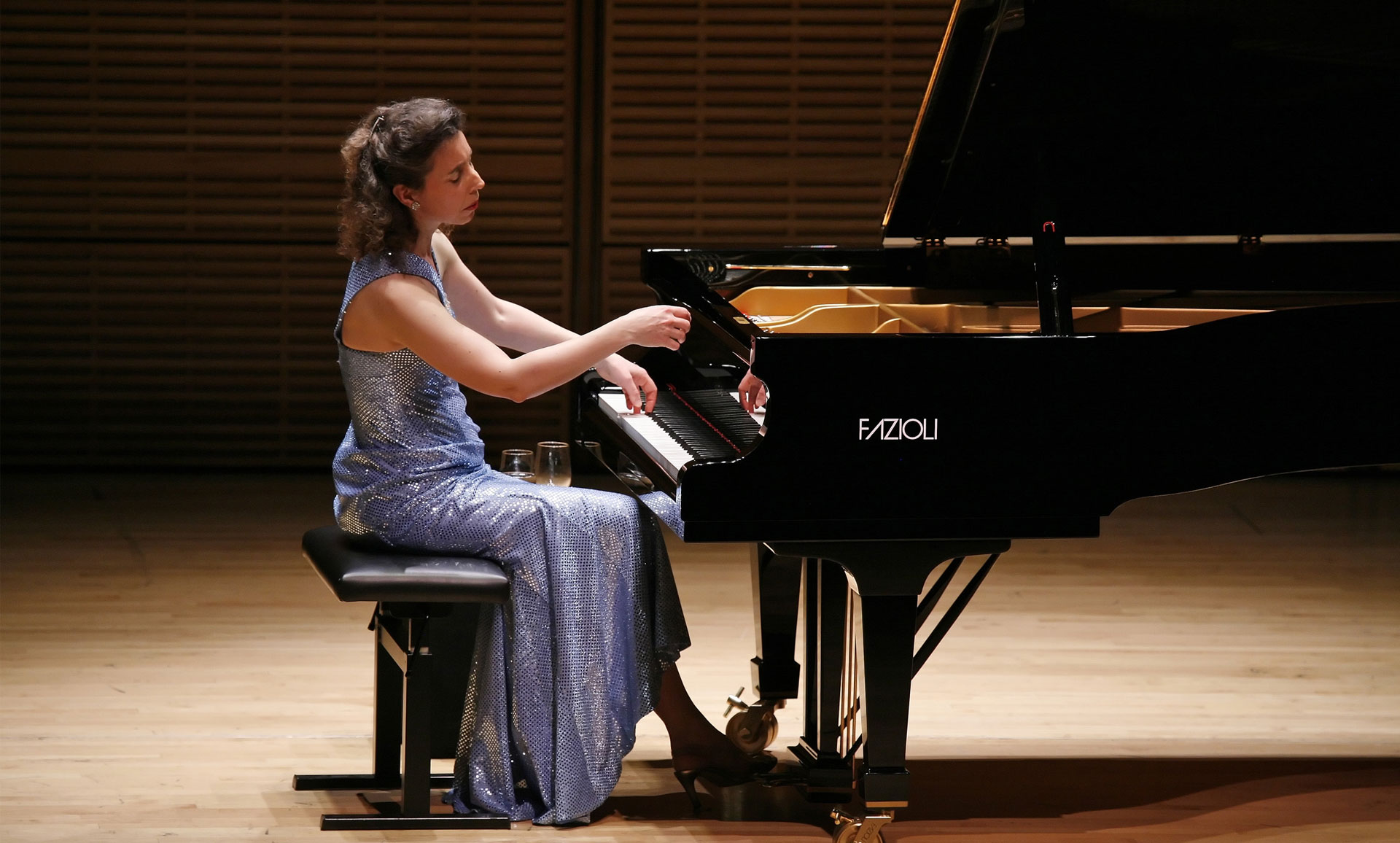
World-renowned pianist Angela Hewitt’s Bach performances on 92NY’s stage are the stuff of modern legend. In the only US presentation of her four-year, 12-concert Bach Odyssey, she packed Kaufmann Concert Hall, earned critical raves, and cemented her position as the Bach pianist of our time. Hewitt joins us next month for a historic 50th-anniversary performance of one of her signature works, Bach’s monumental Goldberg Variations. We sat down with her ahead of the performance to talk about her long relationship with the work, why audiences respond to it so profoundly, and what it might be like for her if – through a magical time machine – Johann Sebastian came backstage after the concert.
Congratulations on your 50-year journey with one of music’s most iconic works. Please tell us about your long relationship with the Goldberg Variations.
I grew up with Bach, as my father was the Cathedral organist in Ottawa. At the age of 16, my piano teacher saw there was to be a competition in Washington DC the following year with the test piece being the Goldberg Variations and suggested I learn it and enter. I started to work on the piece in October, 1974. The competition was the following September – I had just turned 17 – and it was quite an event. There were 50 of us, and the woman who ran it was determined that the judges have no idea of who was playing. So, she had a curtain separating the jury on one side of the stage and the piano on the other – there was even a carpet to the piano so the judges couldn’t tell anything from the footsteps! A 32-year-old Polish woman ended up winning, and two one-hundredths of a mark behind was me. The judges were very surprised when they found they had given a prize to a 17-year-old! Through that came my debut at the Kennedy Center and the National Gallery of Art. So that is why I learned the Goldbergs so young. And I have performed it always since then – it’s one of the pieces I love to play in public, because it makes such an impact on listeners.
Has your musical approach to the Goldbergs changed over the years?
My overall way of interpreting the piece hasn’t changed dramatically, but of course everything has been developed and refined. I made my first recording of the Goldbergs 25 years after I first played it. I’d been working with conductors in England and listening to musicians who were part of the early instrument movement – that had a great influence on me, and resulted in my changing my approach to the work a bit, as I took out a lot of the pedal, changed fingering and tempi, all to make things clearer. Changing to the Fazioli piano opened up a new sound world for me and gave me more freedom. And I have come to emphasize the dance aspects of the music even more than I had – I was a dancer from the age of three, so that element has always been important to me. Life with the Goldbergs, well, it’s such an experience to play it from beginning to end, and to play it for audiences all over the world and see how moved people are by it. Your playing changes with you as you mature in life.
Please share the story of how you came to record the version of the Goldbergs that can be heard on that 1999 recording.
This was in Henry Wood Hall, a former church in London, and a beautiful space. We’d been recording over four days, and by then had the piece covered. My producer and piano tuner and I went out for a nice Japanese dinner, then I had a massage, and we went back to the hall. My producer said, “Why don’t you do it all again?” It was 11:30 at night! But I did. Between 11:30 pm and 1 am, I played the entire piece and ended up giving what was – up to that point – the best performance of the work I had ever given.
Playing an instrument is a very physical thing, it’s mental, it’s emotional – it’s all of that together, and it’s all reflected in that performance. We had worked really hard during those four days, and knowing we had everything we needed, I felt freer and more relaxed. I’d had a lovely dinner, and, well, the massage definitely helped! I play better after I’ve had a treatment – it gets things flowing. Plus, my engineer and piano tuner had come down into the hall to listen, and I always play better when I have an audience of even one or two people. In the end, 80% of the recording came from that one take.
What do you believe it is about the Goldbergs that makes it so universally resonant?
The Goldbergs gives us a feeling of completeness, through its architecture and its beauty – the theme and 30 variations, how they’re set out, and with the theme coming back at the end. We’re totally transformed by all that we’ve heard. So, when the final note sounds, we really have been on a journey, and we come home a different person. It’s a very beautiful thing. Many people say it’s akin to a spiritual experience, and I think this is why – this piece gives us a sense of the completeness we’re always looking for but so rarely find.
Please say more about the journey. Where does Bach take us?
Let me give you a little road map! After the opening theme – which is a stately dance, very beautiful and elegant, and played very differently than when played again at the end – the variations begin. The first 12 are quite down-to-earth, then something changes in Number 13. Bach gives us this beautiful aria that really lifts us up. He then gives us some hijinks in No. 14 before the first minor variation, No. 15, which is sorrowful and bleak. Then we’re back to joy with the festive opening to the second half. It’s Bach balancing despair and hope. When we arrive at Number 25 – the emotional focal point of the variations – I really believe this is a meditation on death – a meditation between Bach and God. Bach lost so many of his children in infancy, and he lost his own parents when he was just a boy, and you feel loss in the music. Of course, Bach never totally despaired, because of his faith. In Number 26, he’s back dancing again, and from here to the end of the variations it’s a gradual crescendo of joy.
The architecture of the Goldbergs is perfect. And the voyage he takes us on is hugely thought out – not just what he’s doing in every variation, but how it all fits into the whole.
The long silence that often precedes applause following a performance of the Goldbergs seems testament to the music’s power. Why do you think it has such a profound effect on the listener?
I think it’s very important that the performer holds a long silence at the end. We have been in another world and we don’t immediately want to return to earth. It’s a very special and important moment. It’s a communion between me and the audience.
Kaufmann Concert Hall has been home to a full decade of your Bach journey. Is there something special to you about performing in this hall?
Well, the sound is wonderful, and I’m playing the excellent Fazioli piano they bring in for me. And the audience – they really come to listen. They’re so attentive and appreciative and they really know their stuff. They also know me now, because I’ve played there often. I couldn’t ask for a better place to play anywhere in New York.
What do you hope listeners experience or take away from this concert?
The great thing about the Goldbergs is that even if someone doesn’t fully understand what’s going on in the music, they appreciate the beauty and the joy. There’s a lot of joy in this piece, and I try to bring that out. It’s also a very visual piece, with all of the hand-crossing and hijinks, so it’s a concert people love seeing, too. My hope is that the audience comes out of the hall feeling joyful – that they’ve experienced something special – and that their hearts and minds feel changed from when they entered the hall. There’s no better piece than the Goldbergs to do that.
Finally, through the wonders of magic, Johann Sebastian comes backstage after the concert. What do you say or ask?
Oh, I think I’d be too moved to say or ask anything! But I’ve spent more hours of my life with Bach than with any other living or dead person(!), and so, I would be interested just to feel his presence – the presence of someone who has occupied so much of my life. I do think, when you’ve played the complete works of someone – as I have with Bach, and the complete sonatas of Beethoven, and now all of Mozart, and especially the ones who were great keyboard players, like those three – you really get a feel for how they must have been. Without being pretentious, I believe you can feel them within the music. So, I think Bach would have had a twinkle in his eye. And a smile. And great warmth. Some people think Bach is so academic and pedagogical, and that is just so wrong. Of course, he’s of his time – the Romantic composers came later – but in his time, Bach was one of the great emotional composers, and I would be happy to feel all of that from him.
Angela Hewitt: Bach’s Goldberg Variations – 50th-anniversary performance – Friday, October 24 at 7:30 pm, in person and streaming. Tickets and details.